Friday's second practice is where teams run something close to a race stint: the same tyres for lap after lap, with fuel on board. We took every driver's longest uninterrupted run from FP2 at Sepang, dropped the out-vueltas, cool-down vueltas and anything under Safety Car or Virtual Safety Car, and kept runs of five vueltas or more. 21 of the 22 drivers produced one.
Two things are not in the data, and they matter. We do not know how much fuel each car carried, and the field was split between soft and medium tyres. Read the numbers as a shape, not a final order.
The pace order
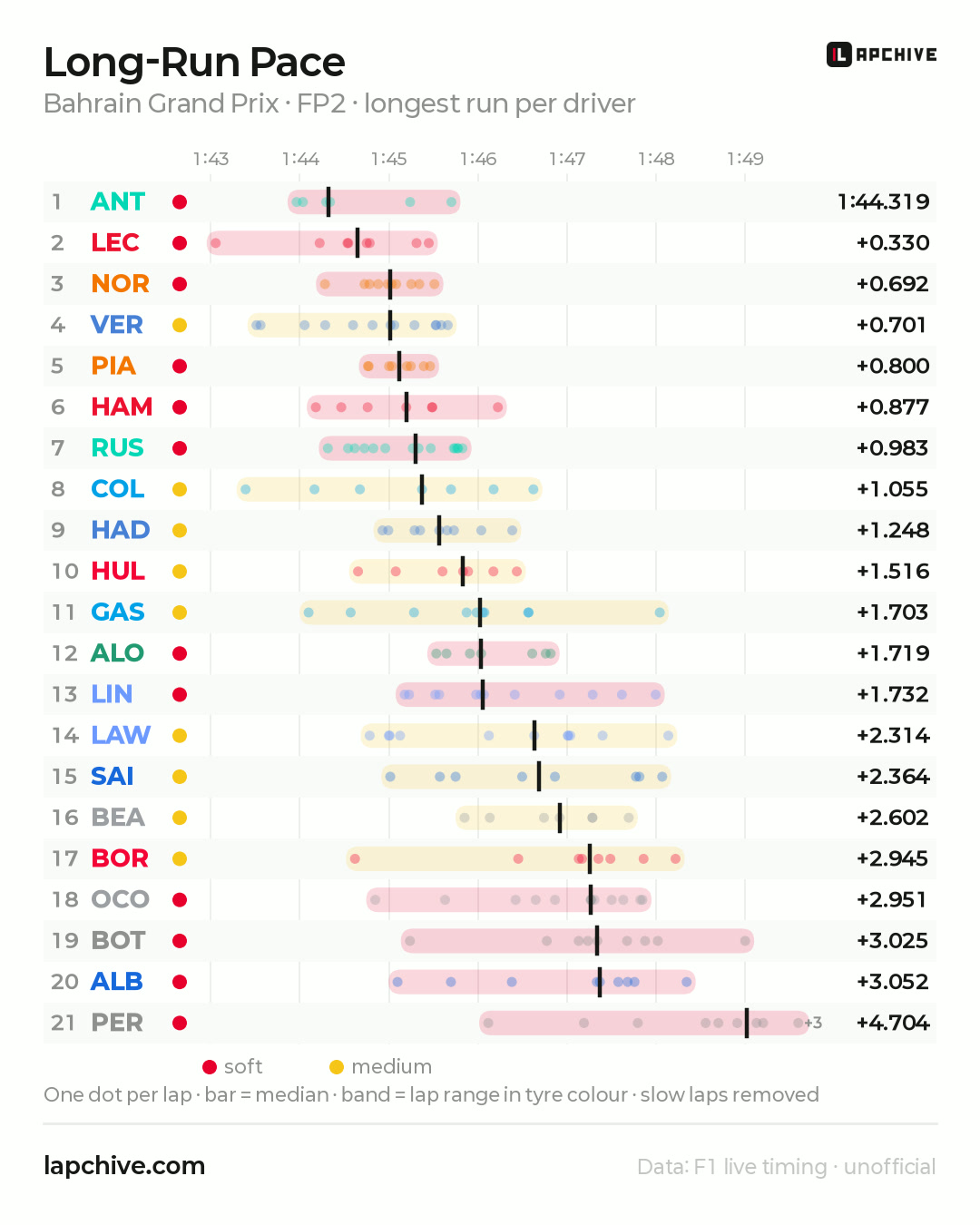
| Piloto | Tyre | Vueltas | Median lap | |
|---|---|---|---|---|
| 1 | Antonelli | Soft | 6 | 1:44.319 |
| 2 | Leclerc | Soft | 8 | 1:44.648 |
| 3 | Norris | Soft | 10 | 1:45.010 |
| 4 | Verstappen | Medium | 13 | 1:45.019 |
| 5 | Piastri | Soft | 8 | 1:45.118 |
| 6 | Hamilton | Soft | 7 | 1:45.196 |
| 7 | Russell | Soft | 14 | 1:45.302 |
On the mediana alone, Antonelli was a third of a second clear of Leclerc and seven tenths clear of Norris. But his run was the shortest of the front group, six vueltas, and short runs flatter the mediana: the tyre has not had time to fade.
The slope tells a different story
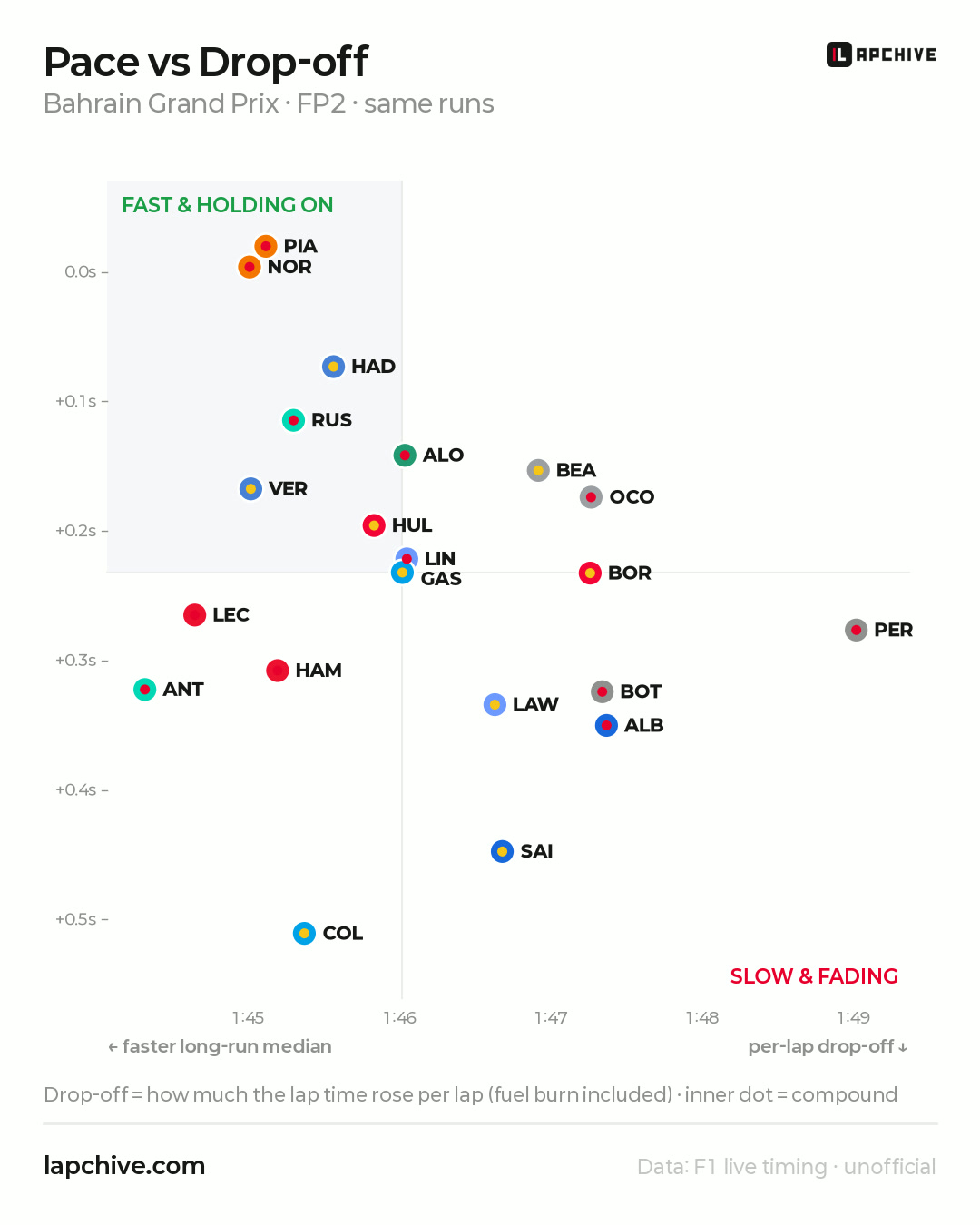
Plot the same runs by how much the lap time rose each lap and the front of the field splits in two. Antonelli (+0.32 s per lap), Hamilton (+0.31) and Leclerc (+0.27) were quick but fading. Both McLarens were flat: Norris −0.004 s per lap over ten vueltas, Piastri −0.02 over eight. Vuelta times normally fall a little as fuel burns, so a flat line means the tyre was losing almost nothing.
A difference of 0.3 s per lap is small on one lap and large over a stint. If those slopes held, the McLarens would close the mediana gap to Antonelli and Leclerc within a few vueltas. That "if" is the honest limit here: six to ten vueltas is not a race stint, and the fuel loads are unknown.
Verstappen's run was the outlier
Verstappen was the only driver in the top seven on the medium tyre, and his run was one of the longest at 13 vueltas. Even so, his mediana of 1:45.019 matched Norris on softs, and his drop-off (+0.17 s per lap) was mild. The next-best medium run in the field was Colapinto's 1:45.373, which faded at +0.51 s per lap, the steepest of anyone.
Our tyre model, built from every long-run lap with each team's base pace removed, puts the soft about 0.38 s faster than the medium when new. Adjust Verstappen's run by that much and it would have been in the fight for the top of the list.
Soft or medium?
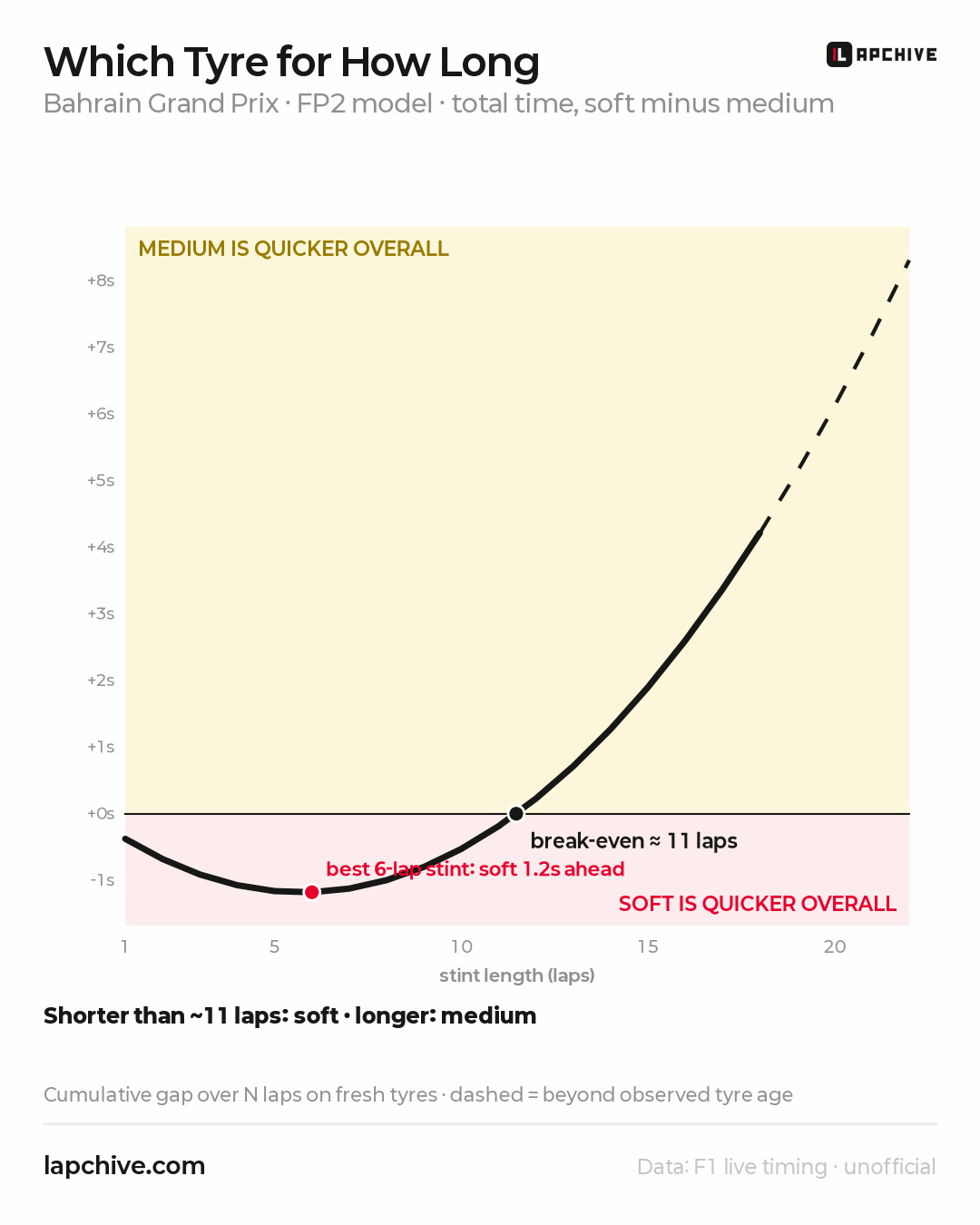
The same model says the soft wears faster: about 0.25 s per lap against 0.18 s for the medium, after an assumed 0.04 s per lap of fuel burn. Starting faster but fading quicker, the soft comes out ahead on total time for a stint of up to about 11 vueltas. Beyond that the medium victorias. The soft's best case is a six-lap stint, about 1.2 s faster overall.
This is the weakest part of the read. Only a few teams split their drivers across both compounds, so the model leans on a small number of direct comparisons.
What Saturday said
Clasificación put Verstappen on pole, 0.298 s ahead of Hamilton, with Hadjar third and Antonelli fourth. That fits the Friday picture of a Red Bull that was quick on the harder tyre and still had pace to find on a single lap. It also leaves la carrera question from Friday open: Mercedes and Ferrari were más rápida over a short run, McLaren held its pace best, and the tyre data favours anyone who can make the medium last.