Russell won the first race of 2026, the Australian Grand Prix, from pole by 2.974 s over his teammate Antonelli, with Leclerc third and Hamilton fourth. On the result sheet it reads like a Mercedes walkover. On the timing sheet it does not: Russell led only 32 of the 58 laps, and for most of the first half he was looking at the back of a Ferrari. The race turned on a single lap of Virtual Safety Car and a decision Ferrari did not take.
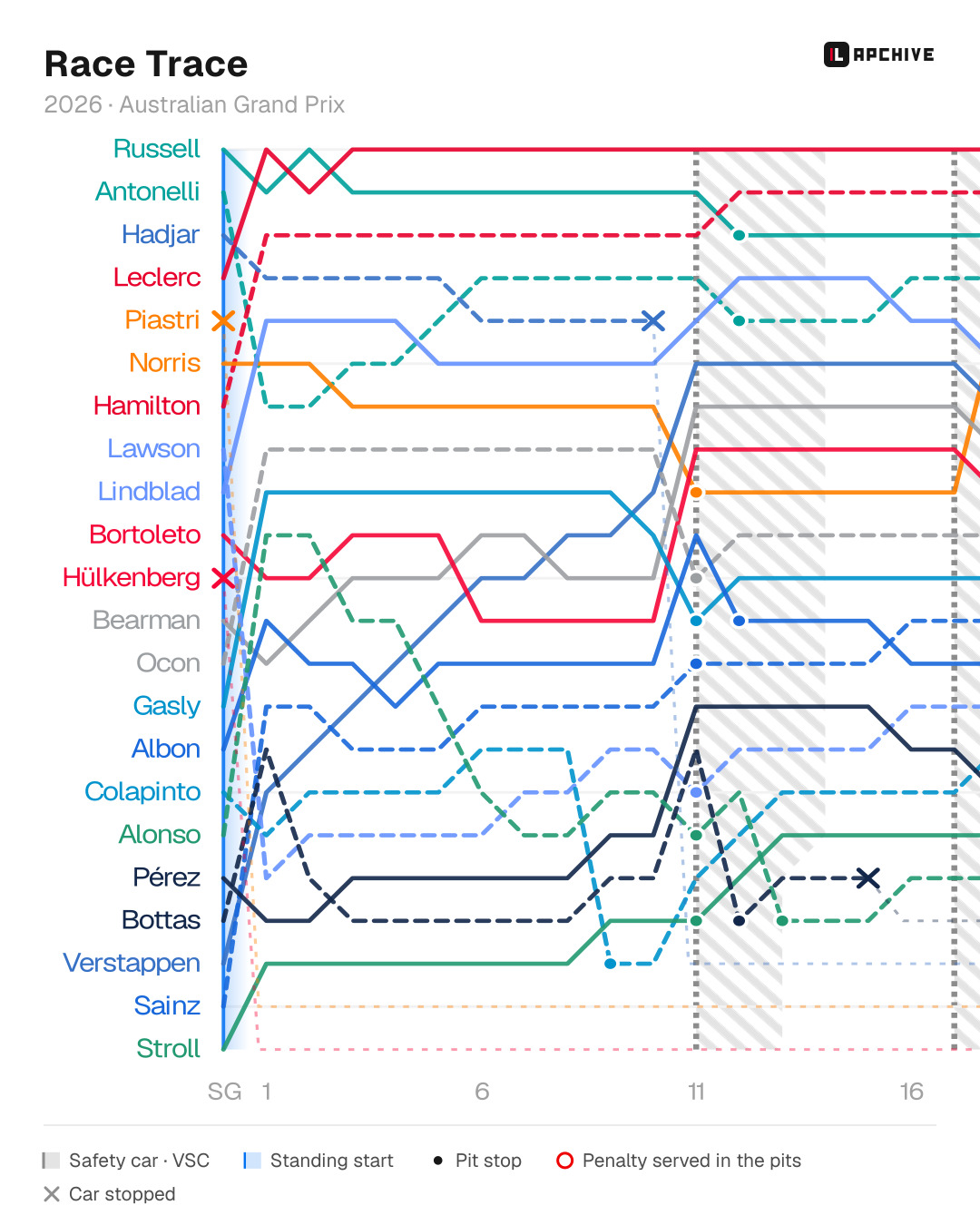
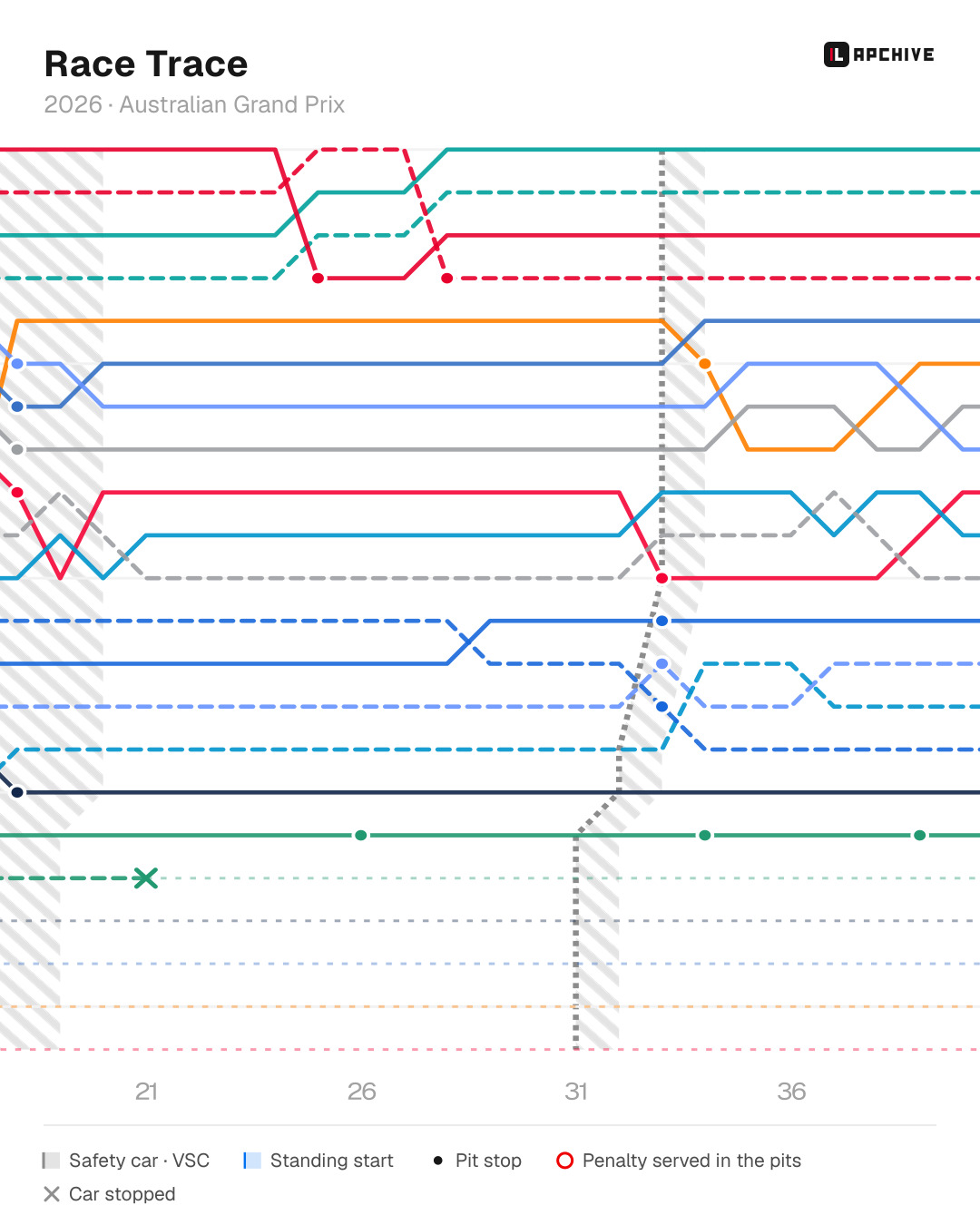
Race trace, full race: every driver's position, lap by lap.
Leclerc from fourth to first
Russell took pole in 1:18.518, 0.293 s clear of Antonelli. The start undid most of that. Leclerc, fourth on the grid, crossed the line at the end of lap 1 in the lead; Hamilton came from seventh to third; Antonelli dropped from second to seventh. Russell was back in front at the end of lap 2, but Leclerc was ahead again a lap later and stayed there. For the next nine laps the two were never more than a second apart at the line. After lap 11 the gap was 0.9 s. All three cars at the front were on mediums.
One lap to decide
Hadjar, who had started third and was running fifth, stopped on track on lap 11, and the Virtual Safety Car was deployed about half a minute later. The timing matters. Leclerc had crossed the line to start lap 12 only about two seconds earlier, so he and Russell had already passed the pit entry. Both then had a full lap at reduced speed in which to decide. Mercedes brought both cars in at the end of it. Ferrari kept Leclerc and Hamilton out.
The cost of a stop under a Virtual Safety Car is the reason teams want one. Across laps 12 and 13, Russell's in-lap and out-lap took 14.4 s longer than Leclerc's two laps behind the VSC. When Leclerc finally stopped, under green on lap 25, his two laps cost 21.2 s against Russell's. Hamilton's stop on lap 28 cost 21.8 s. Russell saved about seven seconds compared with each Ferrari, and he rejoined third, 15.4 s behind Leclerc at the end of lap 13.
Thirteen laps on old mediums
Leclerc's 15.4 s lead was not enough. On new hards Russell was quicker almost every lap, by about half a second a lap over laps 21 to 24, and the lead fell to 5.6 s by the end of lap 24. A second Virtual Safety Car, from lap 18 to lap 20, was another chance to stop cheaply. Verstappen, Bearman, Lindblad, Bortoleto and Pérez took it. Ferrari again did not.
Leclerc pitted on lap 25 and came out fourth, 9.4 s behind Russell. Hamilton, now leading on the mediums he had started on, held the lead for three laps while Russell closed from 2.5 s to 1.0 s, then pitted on lap 28. That handed Russell the lead and he did not lose it. After lap 3, every change of leader came through the pit stops, not on track.
The last thirty laps
From lap 28 the order at the front did not change. Antonelli, who had recovered from seventh to fourth by lap 6 and pitted on the same lap as Russell, was 6.6 s behind him after lap 44 and closed to 2.974 s at the flag. He set the third-fastest lap of the race, 1:22.417, on lap 57. Hamilton finished 0.625 s behind Leclerc after cutting a gap of 7.7 s at the end of lap 33. His hards were three laps newer than Leclerc's.
Verstappen started 20th, after qualifying without a time, on hards. He was sixth by lap 11 when the cars ahead stopped, stopped under the second Virtual Safety Car on lap 18 and again under green on lap 41, and set the fastest lap of the race, 1:22.091, on lap 43 on his fresh set. He finished sixth, 2.876 s behind Norris, who had stopped twice, on lap 11 and under the third Virtual Safety Car on lap 34.
Who did not finish
Piastri and Hülkenberg did not start. Hadjar stopped after 10 laps, Bottas after 15 and Alonso after 21. Stroll was still running at the end but 15 laps down: he stopped four times, and one of those visits, on lap 34, kept him in the pit lane for about 18 minutes. Colapinto served a stop-and-go penalty for a starting procedure infringement on lap 9 and finished 14th. Our data shows where cars stopped and for how long, not why.
What decided it
Leclerc made the better start and led for 23 laps on merit. Russell did not pass him on track after lap 2; he won the race in the pit lane, with a stop that cost him about seven seconds less than either Ferrari paid. The first two Virtual Safety Cars both came while the Ferraris were still on their first set of tyres, and neither time did they stop.