Antonelli won the Japanese Grand Prix from pole, 13.722 s ahead of Piastri, with Leclerc third. On the results sheet it is pole to win. On the track it was nothing of the kind: he was sixth after the first lap and did not lead until lap 21. What put him in front for good was not a pass but a clock. His teammate Russell made his stop 51 seconds before the Safety Car was called; Antonelli made his under it.
Race trace, full race: every driver's position, lap by lap.
Sixth after one lap
Antonelli took pole in 1:28.778, 0.298 s clear of Russell. The start undid it. Piastri went from third on the grid to the lead, and Antonelli finished lap 1 sixth, 3.5 s behind him. The top six all started on mediums, so there was no tyre offset to wait for. He passed Hamilton on lap 2 and Norris on lap 11, and was fourth, 4 to 6 s from the lead, when the stops began. Ahead, Piastri led 16 of the first 17 laps with Russell close behind; nobody in the lead group was pulling away.
Two Mercedes, two different laps
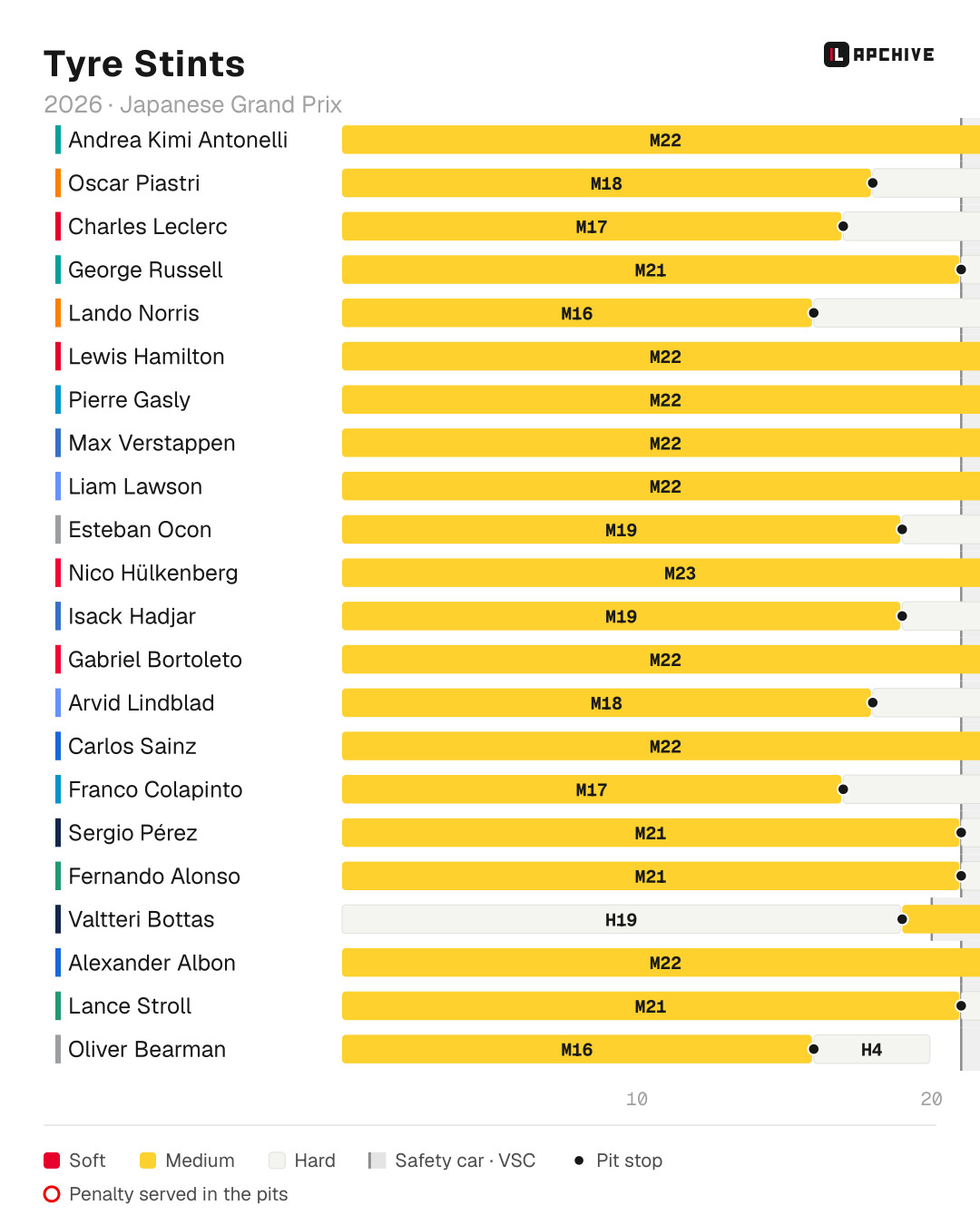
Norris, Leclerc and Piastri stopped for hards on laps 16, 17 and 18. Mercedes left both cars out, and on that old set of mediums Antonelli was the quickest car at the front: 1:34.095 to 1:34.343 on laps 18 to 20, against 1:34.523 to 1:34.987 for Russell, now leading. The gap between them fell from 3.2 s to 2.3 s. Then Mercedes split them. Russell entered the pit lane at the end of lap 21, a moment before Antonelli crossed the line, and Antonelli took over the lead on 21-lap-old mediums. Piastri, on fresh hards, was 18.3 s behind.
Fifty-one seconds
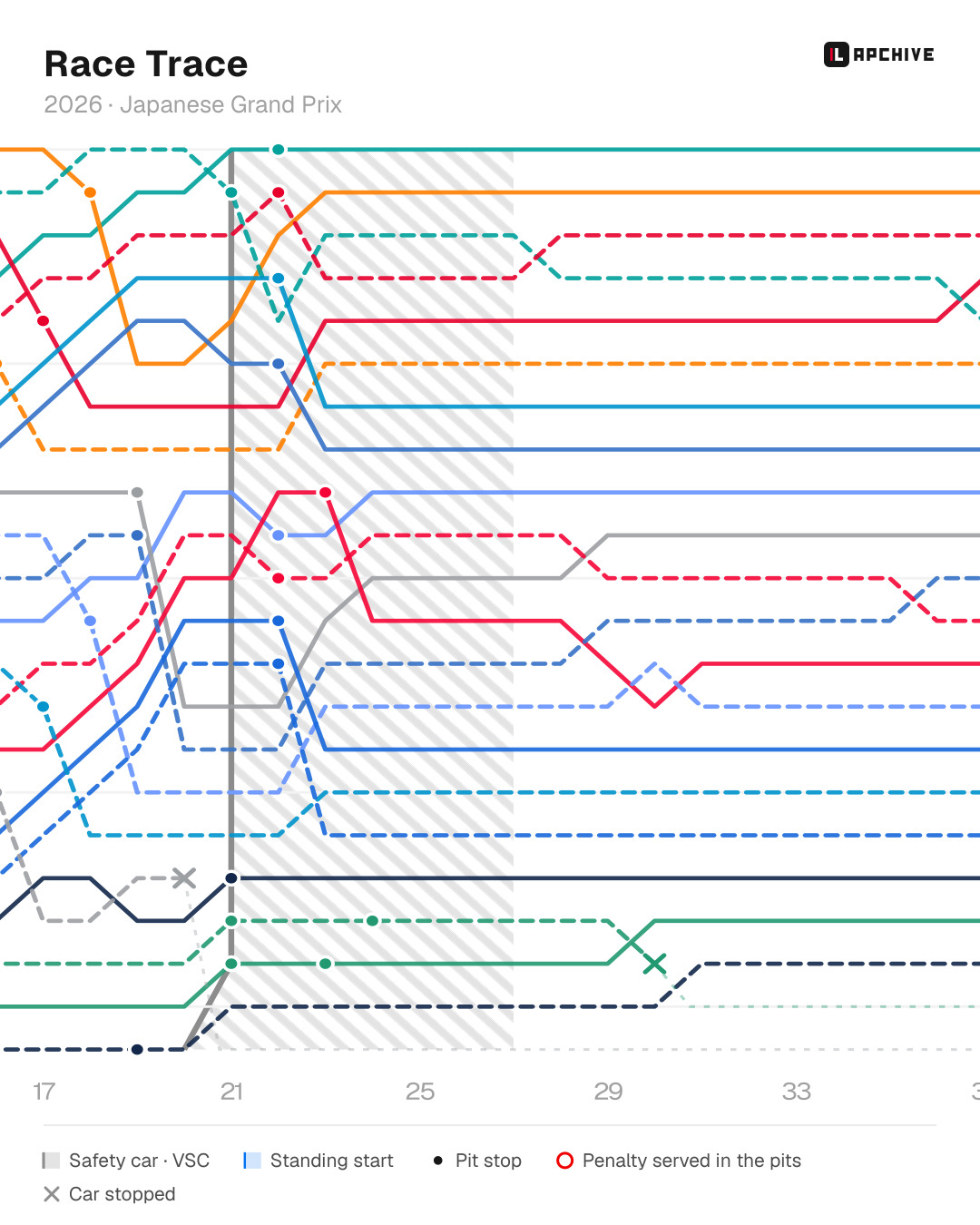
An 18.3 s lead was not enough for a normal stop. Measured on in-lap and out-lap against their usual pace, a green-flag stop cost Piastri and Norris about 22 s each. Antonelli would have come out behind Piastri.
He never had to. Bearman's Haas stopped, yellow flags came out around Turn 13, and the Safety Car was deployed 51 seconds after Russell had turned into the pit lane, with Antonelli halfway round lap 22. He stopped at the end of that lap, with the field slowed behind the Safety Car, and rejoined in the lead. Russell, who had been ahead of him on every lap until his stop, came out of the sequence third. Our data does not say why Mercedes stopped Russell first, only how it fell.
The same timing ran through the midfield. Lindblad was 1.8 s ahead of his teammate Lawson after lap 17 and pitted under green on lap 18; Lawson stopped under the Safety Car and came out 5.7 s ahead of him. Lawson finished ninth for two points, Lindblad 14th.
Twenty-five laps on hards
The Safety Car came in at the end of lap 27, and from there the win was Antonelli's own work. He was 1.580 s ahead of Piastri after lap 28 and quicker than him on 21 of the 25 laps from lap 29 to the flag. His median lap over that stretch was 1:32.912, against 1:33.469 for Piastri. He set the fastest lap of the race on lap 49, 1:32.432. His hards were four laps younger than Piastri's, which explains part of the margin but not all of it: Russell, on a set only one lap older than Antonelli's, had a median of 1:33.454, the same as Piastri.
Leclerc's climb, Russell's slide
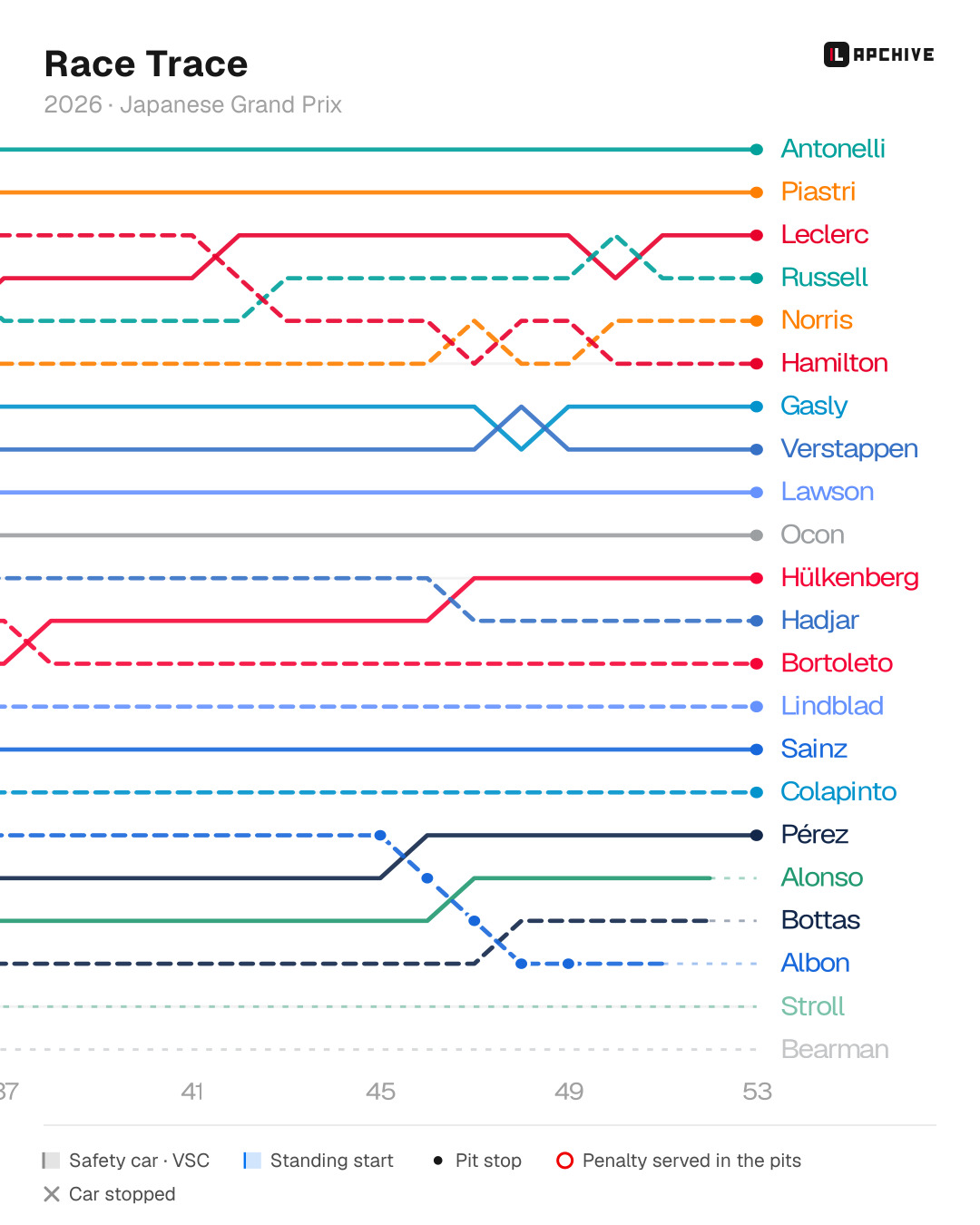
Leclerc had stopped before the Safety Car and was fifth after the stops, behind Russell and Hamilton. He passed Russell on lap 37 and Hamilton on lap 42. Russell got by Hamilton a lap later and ran the last ten laps within a second of Leclerc, took third at the end of lap 50, and lost it on lap 51. Leclerc finished 0.484 s ahead of him. Hamilton, third at the restart, finished sixth.
What decided it
The start cost Antonelli the race and the Safety Car gave it back. Between those moments he did what was in his hands: he passed two cars and, on old mediums, was quicker than his teammate in the laps before the stops. After the restart he did the rest. Russell, who started second and was ahead of him until lap 21, finished fourth, half a second off the podium.