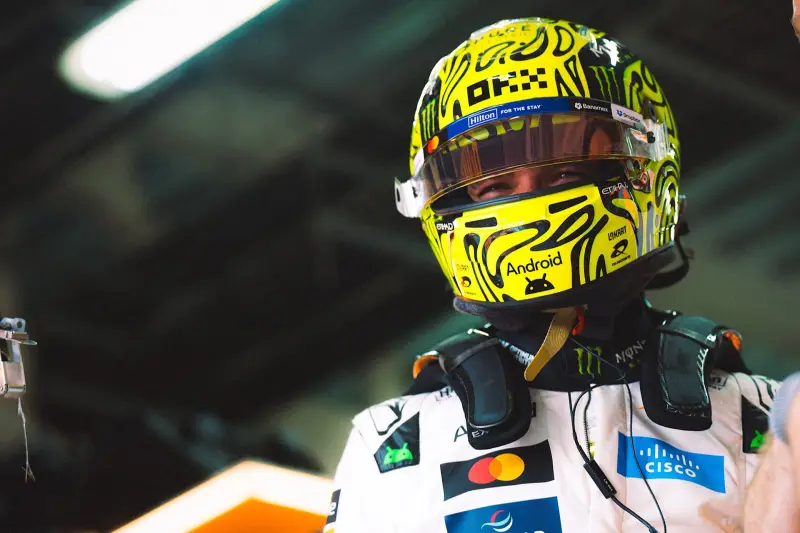
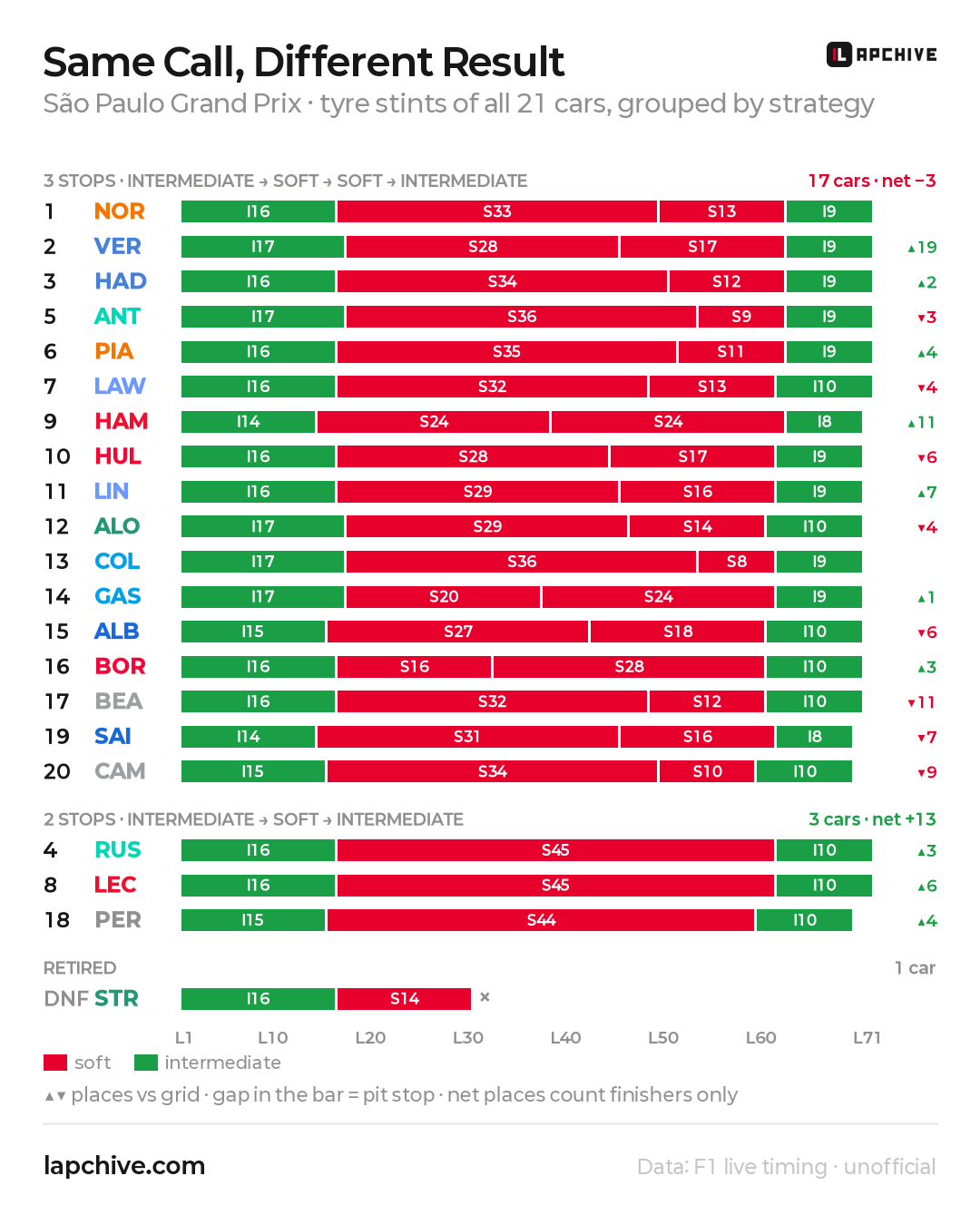
Norris won the São Paulo Grand Prix from pole, 14.602 s ahead of Verstappen, who started 21st, with Hadjar third, 24.485 s back. Two drivers led: Antonelli for the first 19 laps and again for laps 50 to 53, Norris for the other 48. The race ran wet at both ends. All 21 starters began on intermediates, changed to softs between laps 14 and 17, and went back to intermediates between laps 59 and 62 when the rain returned. There was no Safety Car, no Virtual Safety Car and no red flag. Russell was fourth and Antonelli fifth, and those 22 points against Ferrari's six made Mercedes the 2026 constructors' champions.
Race trace, full race: every driver's position, lap by lap.
Saturday: two red flags and a grid rebuilt by penalties
Qualifying was stopped two minutes into Q1 by a red flag for rain and did not resume for 83 minutes. Q2 ended under another red flag and never restarted, so Verstappen, who had not set a Q2 time, was 16th. In Q3 Norris took pole with 1:27.470, 0.204 s ahead of Russell. Corner by corner, Norris was 0.268 s up after the first sector and added 0.022 s through the infield; Russell took 0.086 s back in the last sector.
Five power unit penalties then reshaped the grid. Russell dropped five places to seventh, Verstappen five to 21st, Hamilton nine to 20th, Leclerc ten to 14th, Pérez one. That left Antonelli second, Lawson third, Hülkenberg fourth and Hadjar fifth. Bottas, 17th, never took the start: his car stayed at the pit exit and was classified as not starting.
Qualifying trace: each driver's best lap stepping down through the sessions, with the two red flags.
Laps 1 to 15: Antonelli on intermediates
Antonelli passed Norris off the line and led the first lap by 1.4 s, with Lawson second and Norris third. On intermediates he kept pulling away: 4.5 s after lap 5, 5.2 s after lap 10, 7.0 s after lap 15. Russell had gone from seventh to fifth on the first lap and was third by lap 10. Verstappen, from 21st, was 13th after one lap, seventh after five and fifth from lap 11.
Opening lap: every car on the FIA circuit layout, from the grid to the end of lap 1.
Laps 16 to 20: the lead changes at the switch to slicks
Hamilton and Sainz were the first onto softs, at the end of lap 14. Norris came in at the end of lap 16; Antonelli stayed out a lap longer and stopped at the end of lap 17. That one lap on slicks was worth about six seconds: Antonelli's lead fell from 7.0 s on lap 15 to 0.6 s once both had stopped, on lap 18. On lap 20 Antonelli ran wide at Turn 1. The lap took 1:24.853 and was deleted for track limits; Norris did 1:20.541 and crossed the line 3.4 s in front. Hadjar passed Antonelli a lap later. Antonelli had another lap deleted at Turn 1 on lap 24.
Judged with what Mercedes knew on lap 16, staying out one more lap was not an obvious mistake. The leader had a seven-second cushion, and the first cars on softs had only just started to show what slicks could do. But the timing data shows the cushion was gone before the deleted lap, not because of it.
Antonelli's race trace: 19 laps in front on intermediates, then the switch to slicks.
The dry middle: Norris quicker on softs
Between laps 22 and 44, on softs and without pit stops, the median lap times put Piastri on 1:15.079, Norris 1:15.151, Verstappen 1:15.260, Russell 1:15.457, Hadjar 1:15.517, Hamilton 1:15.678 and Antonelli 1:15.755. Norris was about 0.6 s a lap quicker than the driver he had just passed. The gap between them grew from 3.4 s on lap 20 to 15.2 s on lap 30 and 17.6 s on lap 40.
That is the reverse of Friday. In the FP2 long runs Antonelli had the best median, 1:15.401 over 16 laps on softs, with Norris 0.035 s behind on the hard. Practice fuel loads are unknown and Sunday's track was still drying, so both numbers carry a margin. But the Friday order did not hold for Antonelli once the race went dry.
Norris's race trace: third after lap 1, in front from lap 20.
The second soft stop, and Antonelli's four laps in front
Seventeen of the 21 cars made a second stop for new softs. Verstappen went first of the front group, on lap 45, then Lawson on 48, Norris on 49, Hadjar on 50, Piastri on 51. Antonelli went longest, to lap 53, and led laps 50 to 53 while the others cycled through. He rejoined fifth and set the fastest lap of the race, 1:12.689, on lap 55. Norris was back in front from lap 54.
Verstappen: 21st to second
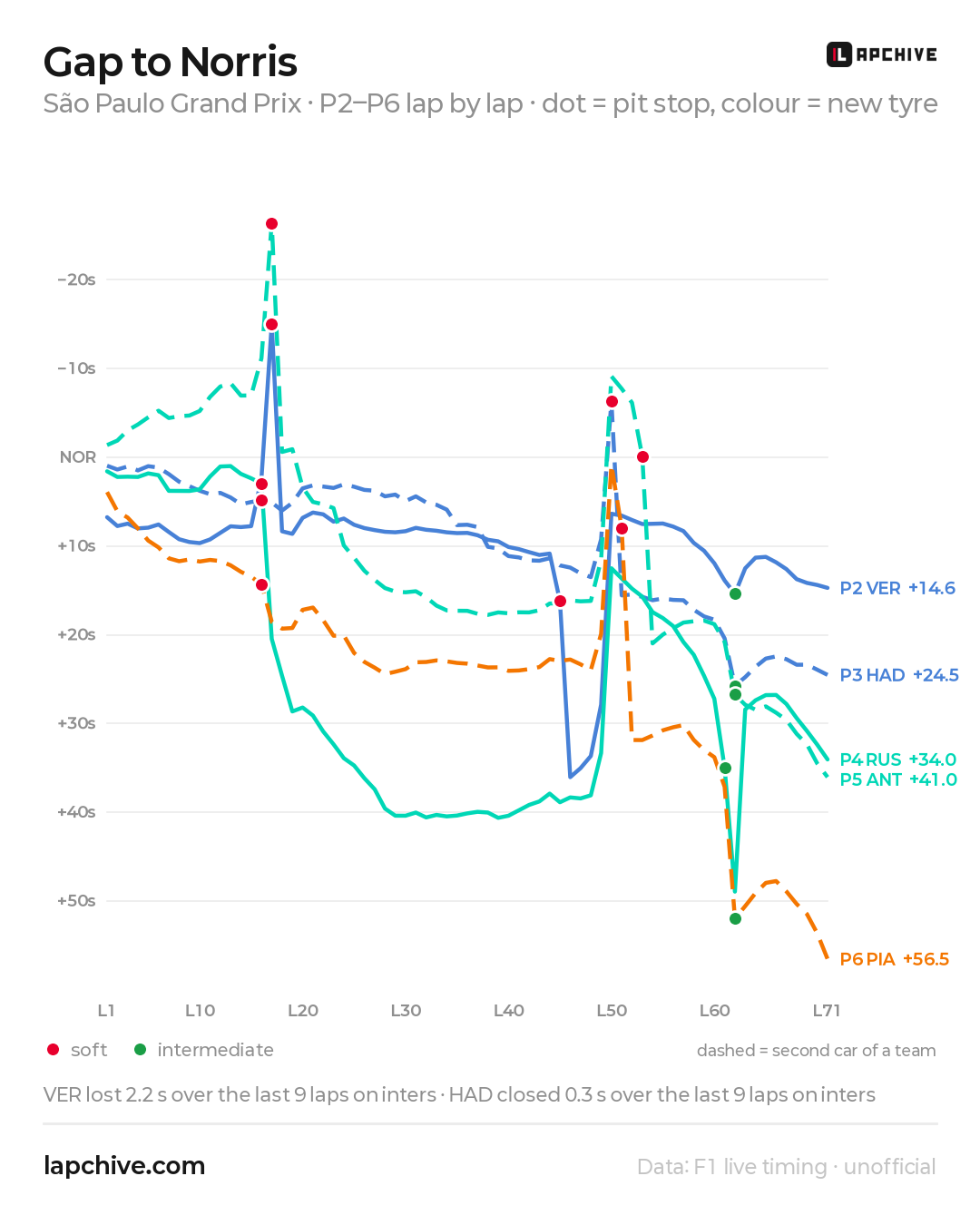
Verstappen's race was built on intermediates. He was 13th after the first lap, fifth by lap 11 and 14.7 s behind Antonelli after lap 15. He stopped for softs at the end of lap 17, came out fourth, was third by lap 25 and second before his second stop. Stopping on lap 45, four laps before Norris and five before Hadjar, kept him ahead of Hadjar; he was second again from lap 54 to the flag. He never got close to Norris: 6.8 s behind on lap 20, 10.1 s on lap 40, 7.5 s on lap 53. On the second set of softs Norris pulled away to 13.9 s by lap 61, and on the final intermediates Verstappen lost another 2.2 s.
Verstappen's race trace: from 21st on the grid to second.
Norris against Verstappen: lap times coloured by tyre, with the stints drawn under the title.
Russell: one set of softs for 45 laps
Three drivers did not make the second soft stop. Russell, Leclerc and Pérez ran one set from lap 16 or 17 until the switch back to intermediates on lap 59 to 61, 44 and 45 laps. As a group they gained 13 places net against the grid; the 17 cars on three stops lost three. Russell was eighth after his first stop, held seventh through the middle of the race and moved up as the others stopped again, fourth on lap 52. Antonelli, on fresher softs, came back past him, but after the final stops Russell was ahead for good from lap 64 and finished 2.0 s in front of his teammate on the road.
Russell's race trace: from seventh on the grid to fourth on one set of softs.
Russell against Antonelli: two stops against three, lap times coloured by tyre.
The rain returns
From lap 59 the cars came back in for intermediates, the last of them on lap 62, and race control activated the low-grip delta again and switched Overtake Mode off. Norris led the final nine laps on intermediates by between 11.2 s and 14.7 s. Hadjar held third, 9.5 s ahead of Russell. Antonelli's last stop was noted for an unsafe release; he finished fifth on the road, 2.0 s behind Russell.
Behind the top five
Piastri was sixth from tenth. Lawson, third on the grid, finished eighth on the road and was promoted to seventh. Leclerc went from 14th to seventh on the road, on the same two-stop plan as Russell, and touched Lawson at Turn 12 on the last lap. Hamilton, from 20th, was ninth after the first lap, fell to 18th after stopping first for softs, and climbed back to ninth on three stops. Hülkenberg, fourth on the grid, took ten seconds during the race for leaving the track and gaining an advantage and finished tenth, a lap down. Lindblad went from 18th to 11th. Stroll retired on lap 30.
Leclerc's race trace: from 14th to seventh on the road on one set of softs.
Hamilton's race trace: from 20th on the grid to ninth.
Leclerc against Hamilton: two stops against three, lap times coloured by tyre.
After the race: one place changes
The stewards gave Leclerc five seconds for causing the collision with Lawson, which dropped him from seventh to eighth and moved Lawson up to seventh. Antonelli and Bearman each got five seconds for unsafe releases; neither lost a place. The investigations into practice-start infringements before the race, noted for Hülkenberg, Pérez, Hadjar, Bottas and Stroll, did not lead to a time penalty in the final classification.
What it means
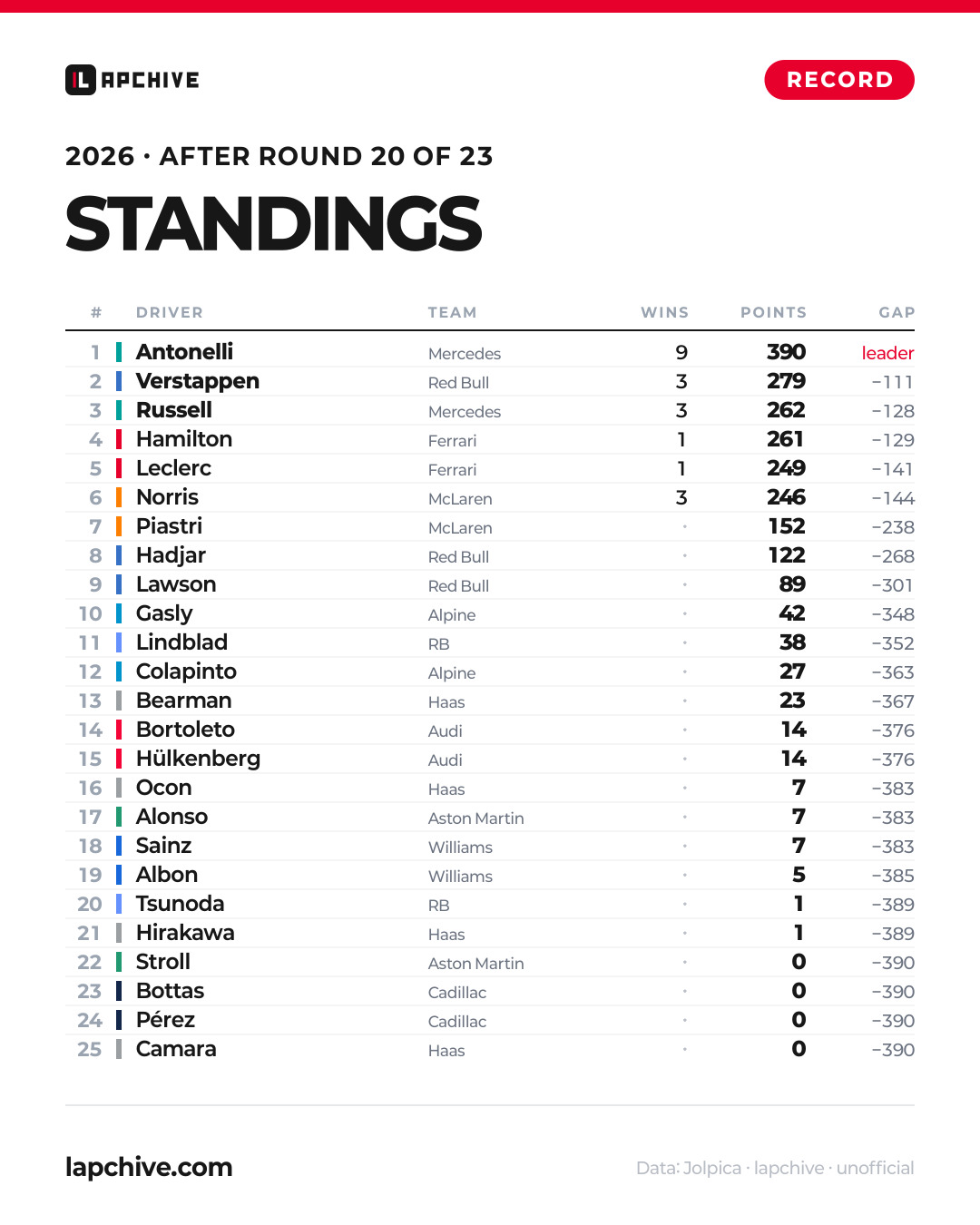
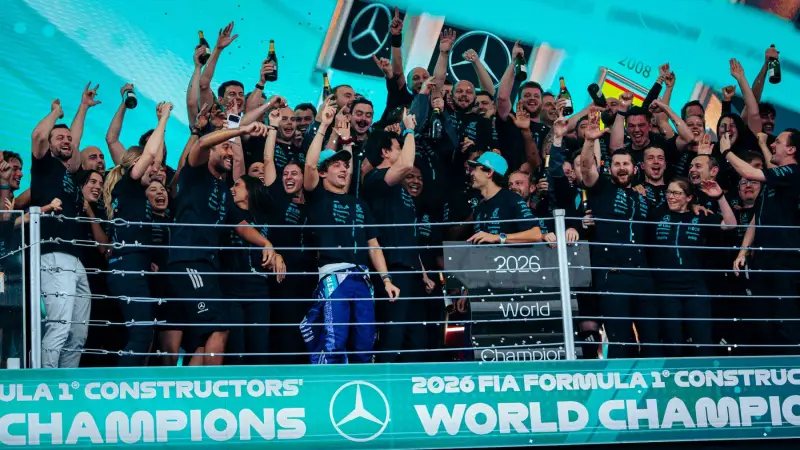
Before the race Mercedes led Ferrari by 126 points, with no sprints left and at most 43 points a weekend for a team. São Paulo gave Mercedes 22 (Russell 12, Antonelli 10) and Ferrari six (Leclerc four, Hamilton two). The lead is now 142 with three rounds left, more than the 129 Ferrari could still score: Mercedes are constructors' champions, a round after Antonelli won the drivers' title. Second place in the drivers' standings moved too. Verstappen's 18 points put him on 279, 17 clear of Russell (262), with Hamilton on 261 and Leclerc on 249. Antonelli has 390.
One limit applies. Our timing data shows when each car stopped and what it gained or lost, not what each team saw on its radar or why it chose that lap.